The 15 Steps to Perfect Mackerel Sushi: Best Techniques for Saba & Sawara
Table of Contents
Introduction
In the world of traditional Edomae sushi, there is perhaps no ingredient more polarizing yet rewarding than mackerel sushi. For the uninitiated, it can be intimidating—a strong-flavored, oily fish with a distinct silver skin that gleams under the sushi bar lights. But for the true connoisseur, the “Hikarimono” (silver-skinned fish) is the highlight of the meal. It is where the chef’s skill is truly tested.
Unlike tuna or scallops, which rely heavily on the inherent quality of the raw ingredient, mackerel sushi relies on the chef’s ability to manipulate flavor and texture through curing. It is a dance between the fish, salt, and vinegar. When done correctly, the result is a bite that is buttery, umami-rich, and cleansed by a sharp acidity that leaves you craving more.
This comprehensive guide will take you from the fish market to the cutting board. We will explore the biology of the fish, the critical safety measures required for serving mackerel for sushi, and the nuanced differences between the robust Saba and the delicate Spanish mackerel sushi. Whether you are a home cook or an aspiring sushi chef, this is your ultimate resource.
1. Understanding the “Hikarimono” Category
To understand mackerel sushi, one must first understand its classification. In Japanese cuisine, sushi toppings (neta) are categorized. Tuna is “Akami” (red meat), flounder is “Shiromi” (white meat), but mackerel falls into “Hikarimono” (shiny/silver things).
Hikarimono are characterized by their shiny skin, which is usually left on the fish for visual appeal and texture. These fish are typically migratory, swimming fast in the open ocean. This activity level creates meat that is high in myoglobin and rich fats. However, this high fat and enzyme content means the flesh degrades rapidly after death.
Historically, before refrigeration, sushi chefs had to find ways to preserve these fish. This necessity birthed the curing techniques we use today. Therefore, when you eat a piece of mackerel in sushi, you are tasting hundreds of years of preservation history. It is not just raw fish; it is cooked chemically by acid and salt.
2. The Two Kings: Saba vs. Sawara
While there are many types of mackerel, two specific species dominate the sushi counter. Understanding the difference is crucial for your shopping list and your palate.
The Classic: Saba (Pacific or Chub Mackerel)
When people simply say “mackerel,” they are usually referring to Saba. This is the workhorse of the sushi world.
- Appearance: Distinctive wavy patterns on the back, looking almost like tiger stripes or worms.
- Flavor Profile: Rich, oily, and possessing a strong “bloody” flavor that requires balancing.
- Preparation: Almost always cured (Su-jime). It is rare to serve raw mackerel saba fish without a vinegar wash because the curing process softens the connective tissue and mitigates the fishy smell.
- Seasonality: Best in late autumn and winter, known as “Kan-Saba,” when the fat content is at its peak.
The Elegant Cousin: Sawara (Spanish Mackerel)
Spanish mackerel sushi offers a completely different experience. Sawara is a larger fish and is actually part of the Scombridae family, but it behaves more like a white fish.
- Appearance: Does not have the tiger stripes of Saba; instead, it often has spots. The flesh is much whiter and softer.
- Flavor Profile: Delicate, sweet, and buttery. It lacks the iron-heavy punch of Saba.
- Preparation: Because it is milder, it is often lightly seared (aburi) or served as Spanish mackerel sashimi with ponzu. It does not need the heavy curing that Saba requires.
3. Sourcing the Best Mackerel for Sushi
The quality of your sushi is determined the moment you buy the fish. You cannot turn bad fish into good sushi, no matter how much vinegar you use. When looking for mackerel for sushi, you must be incredibly picky.
The Eyes and Gills
Look at the eyes first. They should be crystal clear, bulging, and bright. If they are sunken or cloudy, the fish is old. Next, check the gills. They should be a vibrant, deep red. If they are brown or gray, walk away.
Firmness
If you are buying a whole fish, press the belly. It should be firm and bounce back. If your finger leaves an indentation, the enzymes have already begun breaking down the muscle structure. Mackerel saba fish degrades faster than almost any other fish, so firmness is your best indicator of freshness.
The Skin
The skin should be shiny and slimy—in a good way. A dry mackerel is an old mackerel. The iridescence of the skin is what makes mackerel sushi so visually stunning, so ensure it hasn’t faded.
4. Food Safety: Parasites and Freezing
We must address the elephant in the room: Anisakis. Mackerel are notorious carriers of these nematode parasites.
The Freezing Requirement
Even if you buy “sushi grade” fish, you must ensure it has been frozen according to FDA guidelines to destroy parasites.
- The Rule: Freezing and storing at an ambient temperature of -4°F (-20°C) or below for 7 days (total time).
- The Myth: Vinegar does not kill Anisakis instantly. While a long soak might eventually harm them, the standard curing time for mackerel in sushi is not long enough to guarantee safety. Freezing is the only guarantee.
If you catch the fish yourself, you must gut it immediately, as parasites migrate from the stomach to the flesh after the fish dies.
5. Tools of the Trade
To create the perfect mackerel fish sushi, you need specific tools.
- Deba Bocho: A heavy, thick knife used for filleting the fish and cutting through the head and rib bones.
- Yanagiba: The long, willow-leaf shaped blade used for slicing the cured fillets for Nigiri.
- Bone Tweezers: Essential for removing the pin bones (chiai-bone) running down the center of the fillet.
- Zaru (Bamboo Sieve): Used during the salting process to allow excess liquid to drain away from the fish.
6. The Science of Shime Saba (Curing)
The process of making mackerel sushi from Saba is called Shime Saba. It is a two-step chemical cooking process.
Step 1: Dehydration via Salt
When you cover the mackerel saba fish in salt, a process called osmosis begins. The water inside the fish cells, which is less salty than the exterior, rushes out to equalize the pressure.
- Why is this good? Bacteria love moisture. By removing water, you inhibit bacterial growth. Furthermore, the water exiting the fish carries with it trimethylamine, the compound responsible for that “rotten fish” smell. This concentrates the umami flavor.
Step 2: Denaturation via Acid
After washing off the salt, the fish is soaked in vinegar. The acid in the vinegar reacts with the proteins in the fish, denaturing them. This “cooks” the fish without heat, turning the flesh from translucent red to opaque white.
- Texture Change: This firms up the meat, giving mackerel in sushi its signature bite.
7. Step-by-Step Guide to Curing Saba
Here is the master recipe for curing mackerel for sushi.
Ingredients:
- 1 Very fresh Saba (Chub Mackerel)
- 500g Coarse Sea Salt
- 300ml Rice Vinegar
- 1 strip Kombu (Kelp)
- 2 tbsp Sugar
Procedure:
- Fillet: Remove the head and guts. Wash the cavity thoroughly with cold water to remove all blood (blood causes spoiling). Fillet into three pieces (two fillets, one spine).
- Salt: Place the fillets in a tray. Cover them completely with salt. Let them sit for 45 minutes to 1 hour depending on thickness.

- Rinse: Wash the salt off with cold water. Pat the fillets extremely dry with paper towels.
- Marinate: Mix the vinegar, sugar, and kombu. Place the fillets in a Ziploc bag or shallow dish with the liquid. Marinate for 20 to 30 minutes.
- Stop: Remove from vinegar and pat dry. Do not rinse with water this time.
8. Preparing Spanish Mackerel (Sawara)
As mentioned, Spanish mackerel sushi requires a gentler touch. You do not need to bury this fish in salt for an hour.
Procedure for Sawara:
- Fillet: Clean and fillet the Spanish Mackerel.
- Light Cure: Sprinkle a light dusting of salt on the fillet (like seasoning a steak) and let it sit for only 15 minutes.
- Sear (Warayaki/Aburi): The skin of Spanish Mackerel is delicious when cooked. Traditionally, chefs use straw (Warayaki) to smoke/sear the fish. At home, use a blowtorch.

- Score and Torch: Score the skin side. Torch until the skin blisters and fat renders.
- Cool: Let it cool slightly before slicing.
If you are lucky enough to have extremely fresh fish, Spanish mackerel sashimi is incredible. Slice it thin and serve with a dipping sauce of soy sauce, grated garlic, and ginger—a combination that highlights the sweetness of the meat.
9. The Art of Peeling and Pin-Boning
This is the step that separates amateurs from pros. After curing your mackerel saba fish, you must remove the pin bones and the outer skin.
- Pin Bones: Run your finger down the center line of the fillet. You will feel small bones. Use your tweezers to pull them out in the direction they are pointing. If you pull against the grain, you will tear the delicate meat.
- The Skin: There is a thin, clear membrane on the outside of the Saba. It is tough and chewy. Start peeling from the shoulder end (where the head was) and gently peel it back toward the tail. The beautiful silver pattern will remain on the flesh, but the tough plastic-like layer will come off. Note: You generally do not peel Spanish mackerel sushi if you plan to sear it, as the skin adds texture.
10. Making the Sushi Rice (Shari)
Great mackerel sushi is 50% fish and 50% rice. Because mackerel is oily and fishy, it pairs best with a rice seasoned with Akazu (red vinegar) rather than standard white rice vinegar.
Red vinegar is made from fermented sake lees and has a deeper, more savory flavor that stands up to the strong taste of mackerel in sushi.
- Cook short-grain Japonica rice.
- While hot, mix in your sushi vinegar (vinegar, salt, sugar).
- Fan the rice to cool it to body temperature.
- Cover with a damp cloth.
11. Assembly: Nigiri Style
Now, we construct the mackerel fish sushi.
- Slicing: Place the cured fillet skin-side up. Make diagonal slices. If the fish is thick, use a “hidden knife” technique (making a slit on the underside of the slice) so it drapes over the rice better.
- Scoring: For aesthetic appeal and texture, score the top of the silver skin.
- Wasabi: Take a small ball of rice (approx 20g). Place a dab of fresh wasabi on the center of the fish slice.
- Press: Form the nigiri using the traditional hand-press technique. Do not squeeze too hard; you want air pockets in the rice.
- Garnish: This is key. Mackerel sushi is almost always topped with Yakumi (garnishes). The most traditional is a small dab of grated ginger and some finely chopped scallions. This sharpness cuts through the fat.
12. Battera: The Pressed Sushi Alternative
If Nigiri is the style of Tokyo, Battera is the style of Osaka. It is a pressed saba mackerel sushi that is incredibly popular and visually distinct.
The name comes from the Portuguese word “bateira” (small boat) because of its shape. To make this, you need a wooden box mold.
- Lay thin sheets of kelp (shiraita kombu) on the bottom of the mold.
- Place the cured mackerel fillet skin-side down.
- Fill the rest of the mold with sushi rice.
- Press the lid down with significant force.
- Remove the rectangular block and cut it into six or eight pieces.
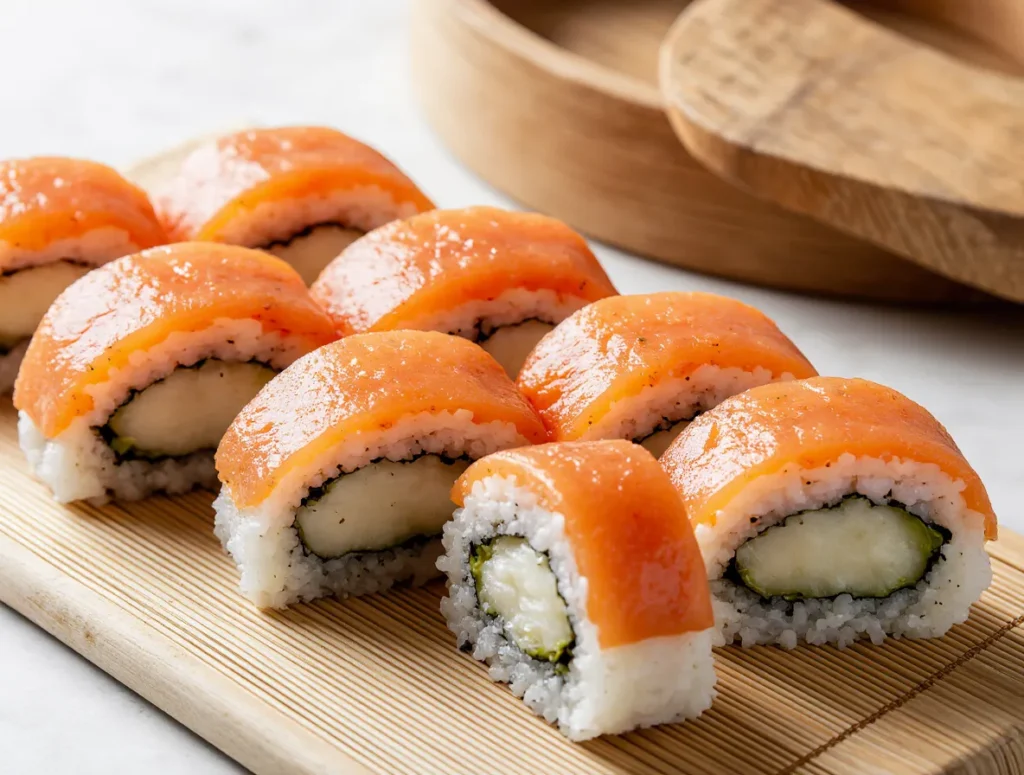
This style of mackerel sushi is more compressed and the flavors meld together over time, making it excellent for bento boxes or takeaway.
13. Nutritional Benefits of Mackerel
Beyond the flavor, there are health reasons to crave mackerel in sushi. It is a nutritional powerhouse.
- Omega-3 Fatty Acids: Mackerel is one of the richest sources of EPA and DHA. These reduce inflammation and support brain health.
- Vitamin D: It is one of the few natural food sources of Vitamin D, essential for bone health.
- Protein: It provides high-quality protein necessary for muscle repair.
However, moderation is advised. While delicious, mackerel for sushi is a moderate-mercury fish (higher than sardines, lower than tuna). Pregnant women should consult guidelines before consuming large amounts.
14. Creating the Perfect Meal: Pairings
You have made the sushi, but what do you serve with it?
Drink Pairings
- Sake: You want a dry sake (Karakuchi) to cut through the oil. A Junmai sake with good acidity works wonders with mackerel saba fish.
- Tea: Hot Green Tea (Agari) is the traditional cleanser. The tannins in the tea wash away the fish oils from the tongue.
Side Dishes
Since mackerel sushi is cold and raw, pair it with warm cooked dishes.
- Miso Soup: A clam or tofu miso soup is standard.
- Grilled Dishes: If you have guests who don’t eat raw fish, offering a cooked protein is smart. You might consider browsing My Chicken Recipes for inspiration on a hot, savory chicken dish that can serve as a contrasting main course for non-sushi eaters. A simple yakitori or teriyaki chicken from that site would fit the Japanese theme perfectly.
15. Conclusion and Final Tips
Mastering mackerel sushi is a journey that takes you deep into the heart of Japanese culinary tradition. It teaches you patience. It teaches you that “freshness” isn’t always about eating something immediately, but about how you treat the ingredient to preserve its best qualities.
Whether you prefer the robust, vinegar-cured bite of a classic Saba Nigiri or the delicate, seared sweetness of Spanish mackerel sushi, the effort you put into sourcing and curing the fish will be evident in every bite.
Final Checklist for Success:
- Freeze your mackerel to -20°C for 7 days to ensure safety.
- Salt generously to remove odors from the mackerel saba fish.
- Rinse with vinegar, not water, after the second stage of curing.
- Slice with confidence and a sharp knife.
- Garnish with ginger to balance the flavors.
By following these 15 steps, you move beyond being a simple home cook to becoming a shokunin (artisan) of your own kitchen. The world of mackerel for sushi is vast and delicious—enjoy the exploration.
Frequently Asked Questions (FAQ)
Q: Can I use supermarket mackerel for sushi? A: Only if it is labeled “sashimi grade” or if you plan to freeze it yourself according to FDA parasite destruction guidelines. Never use fresh fish from a standard counter for mackerel sushi without freezing it first.
Q: Why is my mackerel mushy? A: This usually happens for two reasons. One, the fish wasn’t fresh enough when you bought it. Two, you didn’t salt it long enough. The salt step in preparing mackerel in sushi is crucial for drawing out moisture and firming the flesh.
Q: What is the white film on the mackerel? A: That is the outer skin membrane. While edible, it is very tough. You should peel this off after curing your mackerel saba fish but before slicing it for the best texture.
Q: How do I store leftover cured mackerel? A: Wrap it tightly in plastic wrap and store it in the coldest part of your fridge. It is best eaten within 24 hours, but the vinegar cure does extend the shelf life slightly compared to raw fish.
Q: Is Spanish Mackerel Sashimi safe? A: Yes, provided the fish has been handled correctly and frozen. Spanish mackerel sashimi is a wonderful alternative to the stronger Saba, offering a milder, sweeter taste profile.
For more culinary inspiration, including cooked dishes to round out your banquet, visit My Chicken Recipes.